
FLEET SUCCESS STORY
Kern High School District
How Kern HSD Cut Inventory Shrinkage by $63,000 with RTA Fleet
INDUSTRY
K-12
FLEET SIZE
2815
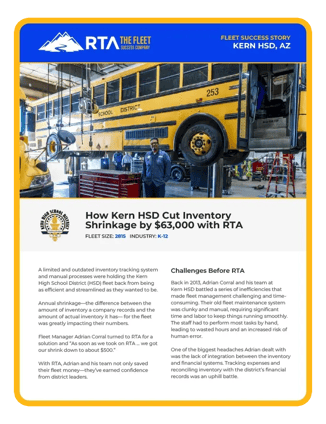
A limited and outdated inventory tracking system and manual processes were holding the Kern High School District (HSD) fleet back from being as efficient and streamlined as they wanted to be.
Annual shrinkage—the difference between the amount of inventory a company records and the amount of actual inventory it has—for the fleet was greatly impacting their numbers.
Fleet Manager Adrian Corral turned to RTA for a solution and “As soon as we took on RTA … we got our shrink down to about $500.”
With RTA, Adrian and his team not only saved their fleet money—they’ve earned confidence from district leaders.
Challenges Before RTA
Back in 2013, Adrian Corral and his team at Kern HSD battled a series of inefficiencies that made fleet management challenging and time consuming. Their old fleet maintenance system was clunky and manual, requiring significant time and labor to keep things running smoothly. The staff had to perform most tasks by hand, leading to wasted hours and an increased risk of human error.
One of the biggest headaches Adrian dealt with was the lack of integration between the inventory and financial systems. Tracking expenses and reconciling inventory with the district’s financial records was an uphill battle.
Kern HSD’s system had no way to easily link parts used for repairs to specific work orders, leading to an unsettling lack of accountability. Parts would disappear from inventory, and no one could pinpoint where they went or how they were used. This poor tracking system led to a $63,000 annual shrinkage—money that could have been better spent elsewhere.
Moving to RTA
In 2013, Kern HSD made the decision to switch to RTA, recognizing that their old system was no longer serving their needs.
“When [the district chose PeopleSoft], they wanted us to join them and do the same business transactions they were doing. Well, in order to get PeopleSoft to do what RTA was doing, and what we needed it to do, it took six months and a little over 300,000 lines of code just to get vehicle information into it,” Adrian recalled.
It took time to get the district to agree to invest in RTA. “The selling point, to be honest with you, was getting the PeopleSoft programmers to admit that PeopleSoft is not a vehicle maintenance program.”
After about a year of back-and-forth with the district, Kern HSD was finally able to get RTA, and the impact has been steady.
With the system fully optimized and running smoothly, the district transformed how it managed its fleet and inventory and was impressed with how the software is able to scale with the district as it continues to grow.
Impact and Results
With RTA in place, that annual shrinkage of $63,000 reduced to just $500 annually, saving the district nearly $500,000 in inaccurate product counts since 2016.
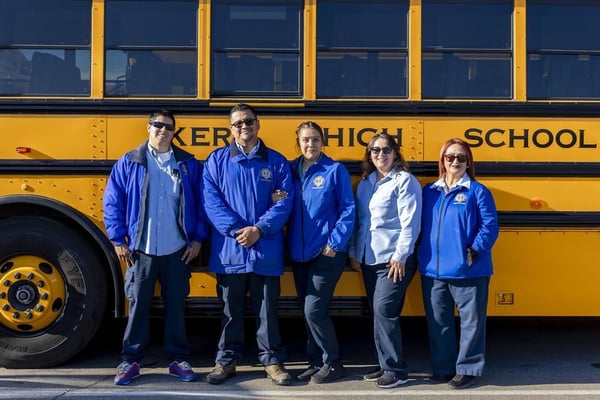
One of the most rewarding outcomes was the improved trust and accountability with the district office. With RTA’s transparent, real-time data, the district office no longer questioned how money was being spent.
We were doing $3 million in transactions from 2013 to 2016, and now it’s almost $15 million. [With RTA], there’s nothing to hide. When I have my budget meetings, my meeting is literally 30 minutes. I do my due diligence, and they never question where I spend the money,” said Adrian.
The transformation from inefficiency and uncertainty to streamlined operations and clear accountability has improved day-today operations and strengthened the overall relationship with district leadership.
Features and Best Practices
The success of RTA’s implementation at Kern HSD can be attributed to several key features and best practices that streamlined inventory management, improved accountability, and allowed the system to scale effectively.
Daily Parts Accountability:
Daily parts accountability was one of the cornerstones of Kern HSD’s new process. To ensure accurate tracking and prevent shrinkage, parts staff were assigned specific responsibilities to perform daily counts of critical items, such as brakes, tires, and shocks.
This daily routine helped identify discrepancies early and ensured that inventory levels were always accurate.
Additionally, the team conducted random audits of 30 different parts each week, making it difficult for any inconsistencies to go unnoticed. This attention to detail has been integral in maintaining a low shrinkage rate year after year.
Layered Accountability:
When parts went missing, the district ensured that technicians and supervisors were included in the email trail, creating a clear chain of accountability.
If a part was not properly logged or was unaccounted for, the fleet manager followed up with a structured process to identify the issue.
As Adrian put it, “If parts are missing, everyone knows they’ll be asked why.”
Gradual System Expansion:
When RTA was first implemented, the district didn’t try to overhaul everything at once. Instead, they started small—tracking 100 parts during the initial implementation.
This gradual approach allowed the team to familiarize themselves with the system without feeling overwhelmed.
Over time, the system was expanded to track over 5,000 parts, and Kern HSD now manages a wide variety of items, from high use components to consumables.
This steady growth helped ensure the team could adapt to the system’s full potential while maintaining accuracy and efficiency.
By combining daily accountability, a structured follow-up process for discrepancies, and a gradual expansion of the system, Kern HSD was able to build a strong foundation for long-term success with RTA.

RTA gave us the tools to stop the bleeding—what once was a huge drain on our budget is now almost non-existent.
- Adrian Corral
Fleet Manager, Kern HSD
