
FLEET SUCCESS STORY
City of Pittsfield
City of Pittsfield Reduces Paperwork and Improves Shop Productivity
INDUSTRY
Government
FLEET SIZE
348
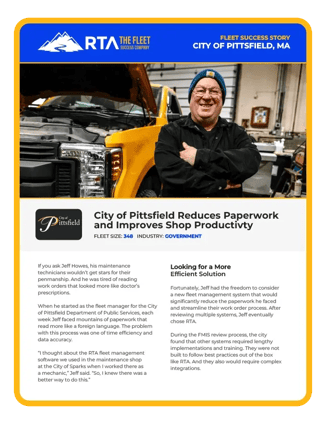
If you ask Jeff Howes, his maintenance technicians wouldn’t get stars for their penmanship. And he was tired of reading work orders that looked more like doctor’s prescriptions.
When he started as the fleet manager for the City of Pittsfield Department of Public Services, each week Jeff faced mountains of paperwork that read more like a foreign language. The problem with this process was one of time efficiency and data accuracy.
“I thought about the RTA fleet management software we used in the maintenance shop at the City of Sparks when I worked there as a mechanic,” Jeff said. “So, I knew there was a better way to do this.”
Looking for a More Efficient Solution
Fortunately, Jeff had the freedom to consider a new fleet management system that would significantly reduce the paperwork he faced and streamline their work order process. After reviewing multiple systems, Jeff eventually chose RTA.
During the FMIS review process, the city found that other systems required lengthy implementations and training. They were not built to follow best practices out of the box like RTA. And they also would require complex integrations.
“The other systems I looked at required a lot of programming to make them compatible with our existing IT system,” Jeff said. “I also saw that it would take a lot of time to train our technicians to use them. I really didn’t have the time or interest in trying to make their systems work with what we already had.”
With a few days of system training and data migration, the shop’s technicians could now log in, create their work orders, and enter their notes – eliminating the paper process. Within a few months, the city had near instant access to their work and could more easily manage the shop’s workflow. Jeff said that accomplishing the same with other systems would have taken a lot longer.
Now, when his technicians find issues that require more time in the shop, he knows about those issues much sooner. “I can better manage expectations,” he added. “RTA has given us the ability to generate reports to see what we need to prioritize for our weekly work schedule.”


We can view vehicle history and determine what has been done previously. That makes it much easier for our mechanics to diagnose issues that weren’t caught earlier. Our technicians can also order parts more easily as they immediately know what parts are needed and when we get them. We can track things more effectively and get work done on time.
- Jeff Howes
Fleet Manager, City of Pittsfield
Realizing Other Benefits of RTA
The City of Pittsfield Department of Public Services garage operates seven service bays. Jeff’s crew of motor equipment repair technicians, services a fleet of 348 vehicles for all the city’s departments except police, and fire and rescue. Except for warranty work, the department’s technicians complete about 90 percent of vehicle and equipment maintenance work including preventive maintenance and repairs.
“I really like the fact that the RTA system is built by people who know and understand vehicle maintenance operations,” Jeff said. “It’s pretty clear those other systems are built by software engineers who don’t understand fleet operations.”
RTA’s Roots Are Planted in Fleet Operations
The company’s founder, Ron Turley, began work as a UPS driver in 1961. Within five years, Ron worked his way to the automotive and building maintenance manager of the UPS Georgia district. In this role, he ran the best-performing district throughout the company. In 1973, UPS promoted Ron to head up maintenance for its fleet of 48,000 vehicles in the United States, Canada, and Germany.
For the next five years Ron instituted time standards and innovative cost-saving measures throughout the company’s maintenance operations. The changes resulted in $100 million in savings and a dramatic increase in productivity – UPS mechanics were able to take care of nearly 80 percent more vehicles per mechanic-hour than they had up to that point.
When Ron left UPS and moved his family back to Phoenix in 1978, he received many requests from fleet managers to help improve their operations. As his popularity grew, Ron routinely delivered seminars around the country in addition to his consultancy work.
In total, he authored four books establishing key reports, metrics, and fleet management processes to help maintenance managers control costs. The books formed the foundation for the RTA. And today, RTA employs prior fleet managers with years of experience across the organization to continue what Ron started.
The City Benefits From Years of Fleet Knowledge
Jeff recognizes that what RTA did for his operation is much like the improvement Ron Turley accomplished at UPS. RTA helps his shop become more productive and reduce its paperwork substantially, he said.
Jeff is now looking forward to the next phase – a completely paperless operation by using RTA.
While looking to the future, Jeff is still finding new savings on a regular basis. “Because we’ve had the RTA system up and running, we earned the city points from our insurance company,” he said. “This has led to a reduction in the city’s rates.”
